











Healthcare can often feel overwhelming for both patients and providers. With complex terminology, emerging treatments, and rapidly evolving technology, clear communication isn’t always easy. That’s where medical narration and medical animation play a vital role.
Today, medical narration and medical animation are changing the way healthcare organizations share information, regardless of language. By combining multilingual voiceovers with engaging visuals, these tools make even the most confusing medical concepts easier to understand. The result? Better communication, less anxiety, and stronger trust between patients, providers, and stakeholders.
From patient education videos and clinical training to medical device demonstrations and public health outreach – medical narration and medical animation turn detailed information into easy-to-follow stories, no matter what language listeners speak. When people truly understand what’s being explained, it saves time, improves outcomes, and makes the entire experience more human.
Case Study:
How Our Medical Narration Helped Amazon During COVID
At the start of the pandemic, Amazon needed to reach customers in over 20 languages, including Arabic, Czech, Hindi, Italian, Marathi, Polish, Latin American Spanish, Tamil, Telugu and more. Amazon’s project needed subtitles and voice overs, and all voice talents were required to have soft voices and timbre. Read how we helped Amazon here.
Why Medical Narration Matters for Patients & Providers
Medical voice overs and animations allow people to hear and see what cannot be easily explained with text alone. For example, when patients can visualize how a treatment works or how a medical device functions, they’re more likely to understand and remember the information. This increases their chances of positive health outcomes. In the same way, medical narration and animation can help providers retain information they may otherwise easily forget.
Healthcare Narration Examples:
How Medical Narration Is Used
Medical Protocols & Compliance Training
Clear narration simplifies HIPAA, safety, and regulatory training for staff.Patient Education Videos
Professional voice overs improve patient understanding and treatment adherence.Healthcare Podcasts
Narrated podcasts build authority and engage clinical and patient audiences.Medical Animations & Explainers
Voice narration brings anatomy, treatments, and device demonstrations to life.Online Medical Courses & eLearning
Medical narration improves retention for clinicians, students, and staff.Dubbing & Localization
Accurate multilingual voice overs ensure culturally appropriate messaging.Multilingual Communication is a Public Health Priority
Whether you’re producing a medical podcast, animating a health explainer video, or building a medical e-learning module, the voice of your message is as important as the content itself. Clear communication isn’t just good practice — it is a must when it comes to public health. A national study in the Journal of General Internal Medicine found that adults with limited English proficiency (LEP) in the United States were more likely to miss provider visits and be overdue for preventive services such as blood pressure and cancer screening than adults without LEP.
Approximately 25.6 million people in the U.S. have LEP. To address this, healthcare providers are investing in multilingual voiceover and dubbing services across digital platforms, telemedicine, and e-learning. Professional medical voice talent and healthcare dubbing help close communication gaps by making complex information accurate, culturally relevant, and easier for diverse audiences to understand and trust.
For this reason, we created a guide to help you choose the right voice talent for your healthcare content, including insights into medical voiceover services, healthcare dubbing, and multilingual healthcare communication.
#1: Decide the type of services your project requires.
Voice over terminology can be confusing. From dubbing and voice over narration to lip-syncing and subtitling, sometimes it’s hard to decide what fits your project best. We wrote some great tips to help you navigate the confusing world of multilingual digital production and decide what services fit your needs the most. In addition, we wrote an article for Multilingual magazine which talks more about these services.
#2: Understand the purpose of your content.
Scientific or Technical: Clinical explainer videos and medical animations require a precise, steady pace and a voice talent who has expertise pronouncing medical terms.
Educational: Medical e-learning voice over or training modules require a voice actor with a calm, instructional tone who is trained to deliver complex terminology with clarity.
Patient Facing: Warmth, empathy, and trustworthiness are crucial for voice overs used in hospital and clinical settings, or as part of multilingual patient communications.
Public or Marketing: Medical podcasts and promotional materials require a voice with personality, energy, and credibility.
#3: Choose a voice actor experienced in medical narration.
– Accurate pronunciation of medical terms
– Professional and confident delivery
– Compliance with industry standards
– The ability to maintain clarity without sounding clinical or robotic
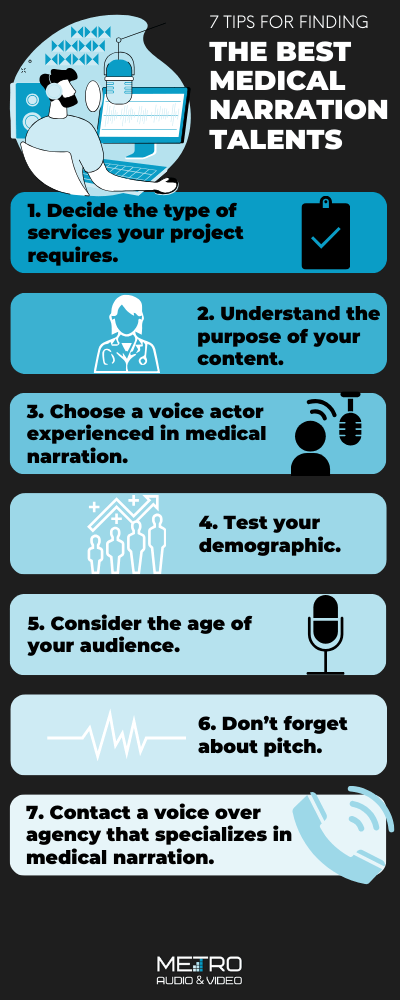
#4: Test your demographic.
While you may think you found the best voice actors, your demographic may disagree. If the voices don’t resonate with your audience, your project may not be a success.
In our previous blog How To Hire a Voice Actor (Even a Foreign Language One!), we discussed why it’s so important to know your target audience. Knowing your audience helps you decide who will be representing you and how you’ll sound in a different language.
You can use a focus group to determine what type of voice appeals to your demographic. For example, if the target audience for your medical device consists of males 30 – 50 years old, you should have males in that age group listen to your selection of actors. If your project is smaller, you can have a focus group with about 3-5 people. However, if you’re working on a project that requires a nationwide campaign, you may want to have a larger group.
#5: Consider the age of your audience.
Yes, age matters when it comes to your audience. For example, if you’re creating a preventive screening or wellness video for a younger audience, you’ll probably want to use more energetic voices. But if you’re designing a video about arthritis or fall prevention for an older audience, you may want the voices to sound calmer and more passive.
#6: Don’t forget about pitch.
Did you know there’s a common condition called presbycusis which makes it difficult for older people to hear higher-pitched voices? Take this into consideration if you have a senior audience. With projects like these, you may want to hire a voice actor with a deeper pitch.
Watch our healthcare marketing videos for Amazon, Aerie Pharmaceuticals & more:
#7: Contact a voice over agency.
Let’s face it – no one knows better than the experts. If you work with a voice over agency, they’ll have a large pool of professional and reliable voice actors to choose from. A voice over agency specializing in medical narration will suggest the best actors and can also hold a casting call to find the perfect match.
Here at Metro Audio and Video, we’ll ask clients looking for foreign language voice over actors to provide us with a translation of their project as well as a “source video” to determine exactly what kind of voice is required. A source video is the original video in English. We also ask our clients what global region the listeners will be from. We can help to localize any project, meaning the original translation will be adapted to listeners in the specific targeted region.
For example, a client may be searching for a voice actor who speaks Chinese. In that case, we’ll ask which region of China listeners will be from. If the target is Mainland China, they will need the actor to speak Mandarin (also known as Simplified Chinese). If the target audience is from Taiwan, we would use a voice talent who speaks Traditional Mandarin, and for the Hong Kong region we would use a Cantonese speaking talent.
What questions do you have for us about finding the best voice actors? Contact us and we’ll be happy to help with any part of your healthcare voice over project, whether it’s in English or a foreign language.
Get a Quote:

Written By Maya Tsirulnik
Maya Tsirulnik is Vice President of Sales and Marketing at Metro Audio and Video. Her background dealing with digital marketing and multimedia localization brings unparalleled knowledge and expertise to the company. Prior to Metro, Maya held finance positions for leading multimedia production companies dealing with multilingual voice overs, localization and translation. She graduated from Baruch College with degrees in business administration and finance.
Maya's insights have been featured in MultiLingual, a leading international localization publication:


Maya is also a Team Lead for the Health and Mental Wellness Program at Women in Localization, a global community that collaborates with educational institutions and industry groups to promote the localization profession and provide valuable resources and opportunities for its members.

Email Maya Tsirulnik or connect with her online: